
Automatic gates operate under constant demand. Every open-and-close cycle engages the motor, stresses the drive mechanism, and exposes the hardware to Singapore’s heat and humidity. Over time, these conditions wear components down quietly, gradually, and without obvious signs until a failure occurs.
Homeowners who wait for something to go wrong before calling a technician often face outcomes that are more disruptive and more costly than necessary. Preventive maintenance for automatic gates takes a different approach: addressing wear before it becomes damage, and identifying emerging issues before they escalate into system failures.
Understanding what this involves helps homeowners make better decisions about protecting a system they rely on daily.
Why Does Singapore’s Climate Make Gate Maintenance More Critical?
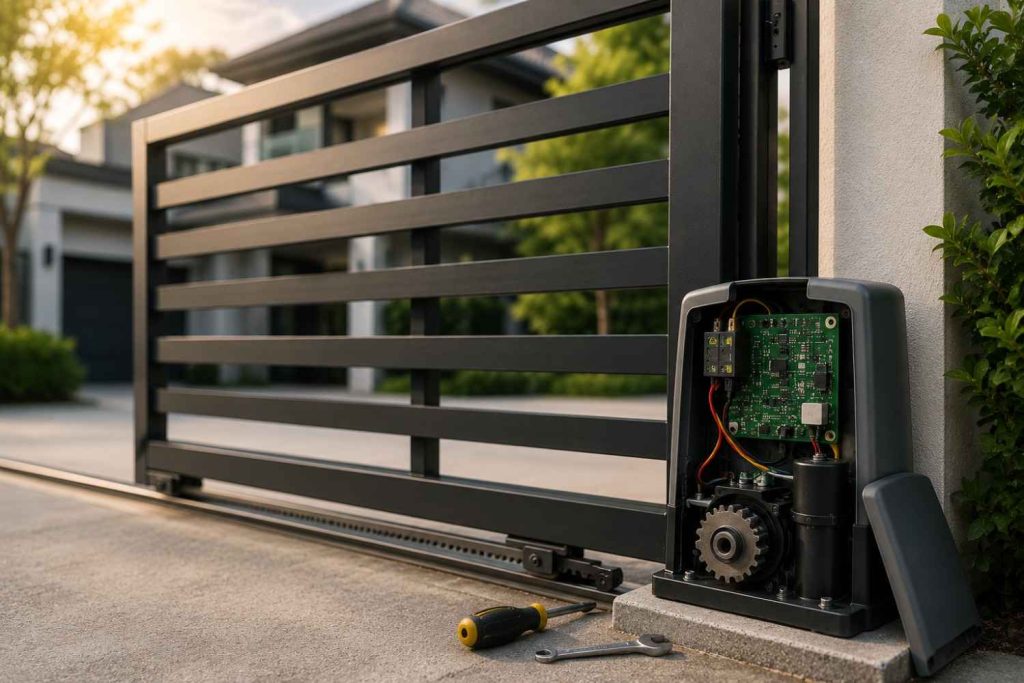
Singapore’s tropical environment is demanding on outdoor mechanical systems. Humidity accelerates corrosion on metal components and electrical connections. Heat degrades rubber seals, lubricants, and cable insulation at a faster rate than in cooler climates. Heavy seasonal rainfall introduces moisture into enclosures and gate tracks. Properties near the coast face the additional exposure of salt air, which compounds surface and electrical deterioration significantly.
These are not exceptional conditions, they are the everyday environment that a gate operates in across its entire service life. Servicing intervals need to reflect that reality.
A motor working against corroded rollers or a debris-filled track draws more power than it should, shortening its lifespan in ways that are not visible until the damage is done.
What Does a Professional Gate Service Inspection Cover?
A thorough automatic gate servicing visit addresses every system that affects performance and operational safety, not just a visual walkthrough.
Mechanical components – Rollers, hinges, bearings, and tracks are cleaned, inspected for wear, and lubricated with materials suited to the gate type and local conditions.
Motor and drive system – The motor is assessed for overheating, abnormal vibration, and reduced output. Gearbox condition and motor mounting integrity are checked.
Electrical systems and control panel – Wiring, terminal connections, and the control board are inspected for corrosion, loose connections, and moisture ingress, all common issues in Singapore’s humid environment.
Safety features – Photocell sensors, motion detectors, and the auto-reverse function are tested to verify correct, calibrated response. A safety component that has drifted out of specification offers no reliable protection.
Gate alignment and structure – The gate frame, hinge points, and overall alignment are reviewed. A gate running out of true places excess load on the motor, accelerating wear across multiple components.
Remote controls and access systems – Remotes, keypads, and intercom connections are verified for reliable, consistent operation.
What Are the Consequences of Skipping Scheduled Servicing?
The deterioration that follows deferred maintenance is rarely sudden. It accumulates, which is precisely why it is easy to overlook until the consequences are unavoidable.
A motor working against increased resistance draws higher current. Sustained over-current operation generates heat that degrades insulation and shortens working life. A safety sensor that has drifted slightly out of alignment may pass a casual check but fail to detect an obstruction when it matters. A corroding electrical connection introduces intermittent faults that become permanent failures.
By the time a gate stops operating, or operates unsafely, the root cause has typically been developing for months. Emergency repairs at that point are more complex and more expensive, often requiring component replacements that routine servicing would have prevented.
The case is straightforward: a scheduled service visit costs less than a reactive repair, and considerably less than a motor or control board replacement.
How Often Should an Automatic Gate Be Serviced?
The standard for residential automatic gates is a minimum of once every twelve months. For properties with higher daily usage, multiple vehicles, or frequent visitors, a six-monthly interval is more suitable.
Between visits, homeowners can take practical steps to slow the rate of wear:
- Clear the gate track regularly – Grit, leaves, and debris increase motor load on every cycle
- Rinse the gate surface – Removing dirt and salt deposits slows corrosion on metal panels
- Listen during operation – New sounds such as grinding, scraping, or hesitation are early indicators of a mechanical issue
- Test safety sensors periodically – Place an object in the gate’s path during closing and confirm the auto-reverse responds correctly
- Keep the control panel enclosure sealed – Moisture and insects entering the panel are a common cause of electrical faults
These steps do not replace professional servicing, they reduce accumulated stress between visits and help homeowners spot warning signs early.
When Should a Gate Be Serviced Outside Its Regular Schedule?
Certain signs indicate a gate needs attention before the next planned visit:
- Noticeably slower opening or closing speed
- Grinding, clicking, or scraping during operation
- The gate reverses unexpectedly or stops mid-cycle without obstruction
- Remote controls requiring repeated presses to trigger a response
- Visible rust, structural damage, or misalignment on any component
These are not minor inconveniences to observe over time. They signal abnormal stress within the system, and addressing them promptly prevents a maintenance issue from becoming a replacement one.
Looking to Schedule a Gate Service?
If your automatic gate is due for an inspection or you want to set up a regular maintenance schedule, EZ Gates provides professional automatic gate servicing for Singapore landed properties. Contact EZ Gates to arrange a visit or learn more.
Frequently Asked Questions
A correctly specified residential motor that receives scheduled servicing typically lasts five to ten years. Without maintenance, thermal stress and corrosion shorten that lifespan considerably.
Surface cleaning, track clearing, and basic lubrication of visible hinges and rollers are manageable for homeowners. Internal motor components, electrical connections, and safety sensor calibration require a qualified technician.
Yes. Corroding connections, drying lubricants, and gradual sensor drift are not detectable through normal daily operation. Preventive servicing identifies these conditions before they produce a visible or disruptive problem.