
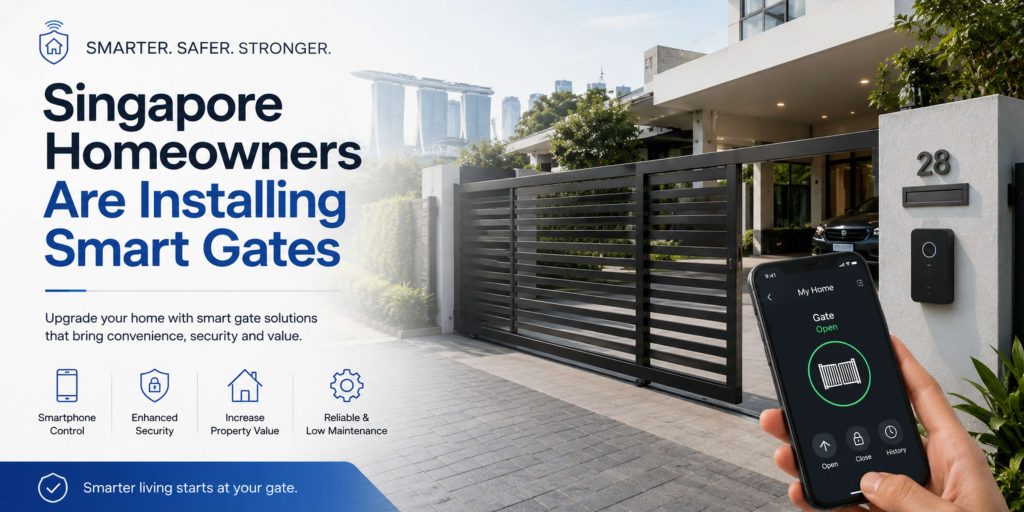
Home security in Singapore has changed considerably over the last decade. Alarm systems have grown more sophisticated, surveillance cameras have become affordable and accessible, and digital door locks have replaced traditional keys in many households. Yet one upgrade that continues to gain steady ground among landed property owners is something far more visible, the front gate itself.
An increasing number of homeowners are moving away from manual gates and installing automatic gate systems in their place. The shift is not driven by novelty. It is driven by practical needs, such as more reliable security, easier daily access, and better control over who enters the property. For many families, upgrading the gate is one of the most impactful changes they can make to their home and often one of the most underestimated.
This guide explains what automatic gate systems involve, the real benefits they offer, and what to think through before making a decision.
Is Your Manual Gate Actually Keeping Your Home Secure?
The front gate is the first physical boundary of any property. It is also the point most homeowners think least carefully about when it comes to long-term security.
A manual gate provides a basic barrier, but its effectiveness depends entirely on consistent human behaviour. Latching it every time. Closing it fully. Remembering to do both during a rushed school run, a late-night return, or a moment of distraction. In practice, manual gates are left open or unlatched more often than homeowners realise.
Secure home entrances require something more dependable than memory and habit. An automatic gate system closes and locks consistently every time, without exception. Many systems can be programmed to auto-close within seconds of a vehicle passing through, so even if attention drifts, the gate will not stay open behind you.
Why Is Getting Out of the Car to Open a Gate Still Normal in 2026?
This question is worth sitting with for a moment. For a country as technologically advanced as Singapore, the sight of someone stepping out of a car in the rain to manually push open a gate remains surprisingly common.
The daily friction of a manual gate adds up. Every time a family member has to get out, open the gate, walk back, move the vehicle, and return to close it again. Multiply that by every person in the household, every day, across months and years.
Automatic gate systems remove this entirely. A remote control, a keypad, or a mobile app opens the gate before the car even reaches the driveway. The gate closes on its own. No one needs to step out, regardless of the hour or the weather.
For households with young children, elderly residents, or anyone who frequently arrives home after dark, this is not a minor convenience, it is a meaningful quality-of-life improvement.
Can You See Who Is at Your Gate Without Leaving the House?
Modern gate automation does not stop at opening and closing. When integrated with intercom systems and cameras, it gives homeowners visibility and control over their entrance from anywhere in the house or anywhere in the world.
A visitor arrives while you are in the middle of a meeting. You check your phone, see their face on the camera feed, speak with them through the intercom, and unlock the gate remotely. The whole exchange takes under a minute and does not require you to move.
For homeowners who travel regularly, this becomes even more valuable. Helpers, contractors, or family members can be given access through a temporary remote code or mobile permission, without handing over a physical key. When their visit ends, that access can be revoked immediately. There is no key to retrieve, no lock to change.
This kind of granular control over secure home entrances was simply not achievable with a traditional gate setup.
Sliding Gate or Swing Gate, Which One Actually Fits Your Property?
Choosing the right type of automatic gate matters as much as choosing to automate at all. The wrong configuration for your driveway layout can create operational problems, safety hazards, or unnecessary maintenance down the line.
Sliding gates move horizontally along a fixed track. They are the better option for driveways with limited width or where there is insufficient space for a gate to swing open freely. From a structural standpoint, sliding gates handle Singapore’s wind and rain conditions well. The gate’s weight is supported by rollers rather than exposed to wind pressure like a large panel. For smaller frontages, corner lots, or properties with vehicles parked close to the entrance, sliding gates are usually the practical choice.
Swing gates open inward or outward from a hinge point, similar to how a large door operates. They suit wider driveways and properties where a symmetrical, traditional gate aesthetic is preferred. Most landed homes in Singapore install inward-opening swing gates in accordance with road safety and urban planning guidelines. Swing gates can also be retrofitted with automation motors, making them a viable option if the existing gate structure is still sound.
The right choice comes down to your specific driveway dimensions, the available clearance, ground conditions, and daily usage patterns. A proper site assessment before purchase will prevent costly decisions made on assumption alone.
What Safety Features Should Every Automatic Gate Have?
A gate that moves under motorised power is a gate that can cause serious injury if it lacks the right safeguards. Safety features are not optional extras. They are the minimum requirements for any responsible installation, particularly in a household with children, elderly residents, or pets.
Any properly specified automatic gate system should include the following:
- Motion sensors – Detect obstructions in the gate’s movement path and stop operation immediately
- Safety photocells – Infrared beams positioned across the gate opening that halt or reverse movement the moment the beam is broken
- Auto-reverse function – Triggers immediate reversal if the gate meets resistance during closing
- Manual release – Allows the gate to be opened by hand in the event of a power failure
- Loop detectors – Ground-embedded sensors that detect a vehicle’s presence and trigger the gate automatically without the need for a remote
Always ask for confirmation that these features are included before committing to any installation.
Does an Automatic Gate Connect to the Rest of Your Home Security System?
For homeowners who have already invested in cameras, smart locks, or a home alarm system, gate automation is a natural extension of that existing setup rather than a separate purchase.
A connected automatic gate system can be monitored through the same app or platform managing other security devices. Every gate opening can generate a notification on your phone. Access logs can be reviewed at any time. Alerts can be triggered if the gate operates outside expected hours.
This creates a security perimeter that begins at the property boundary rather than at the front door, which is where meaningful protection should start. Singapore’s Smart Nation infrastructure has made this kind of integrated home security increasingly accessible, and the gate is a logical part of that picture.
What Actually Determines How Long Your Gate System Lasts?
Installation quality matters, but it is only the starting point. The long-term performance of an automatic gate system depends significantly on maintenance habits and a few key specifications chosen at the time of installation.
- Motor capacity relative to gate weight is one of the most overlooked factors. A motor rated below the actual weight of the gate will run hot, wear out faster, and fail earlier than expected. Ensure the motor’s rated capacity comfortably exceeds the gate’s weight.
- Track and roller condition affect how smoothly a sliding gate operates over time. Without periodic cleaning and lubrication, friction increases, movement becomes uneven, and mechanical components wear prematurely.
- Sensor alignment shifts gradually, especially after heavy rain or minor ground movement. Safety sensors should be checked and recalibrated periodically to ensure they continue to function as intended.
- Routine servicing, typically every six to twelve months, allows a technician to inspect wiring, motor condition, mechanical wear, and safety features before a small issue becomes a failure. The cost of a service visit is far lower than an emergency repair or full system replacement.
A well-specified gate that is properly maintained will serve a property reliably for many years.
Thinking About Upgrading Your Gate?
If you are considering an automatic gate system for your Singapore landed property, EZ Gates provides professional consultation, installation, and after-sales support tailored to your home’s layout and requirements.
Frequently Asked Questions
In many cases, yes. If the gate’s structure, material, and condition are suitable, a motor can be installed without removing the existing gate. A site assessment will determine whether conversion is feasible.
Most systems include a manual release mechanism that allows the gate to be operated by hand when there is no power. This should be confirmed before installation.